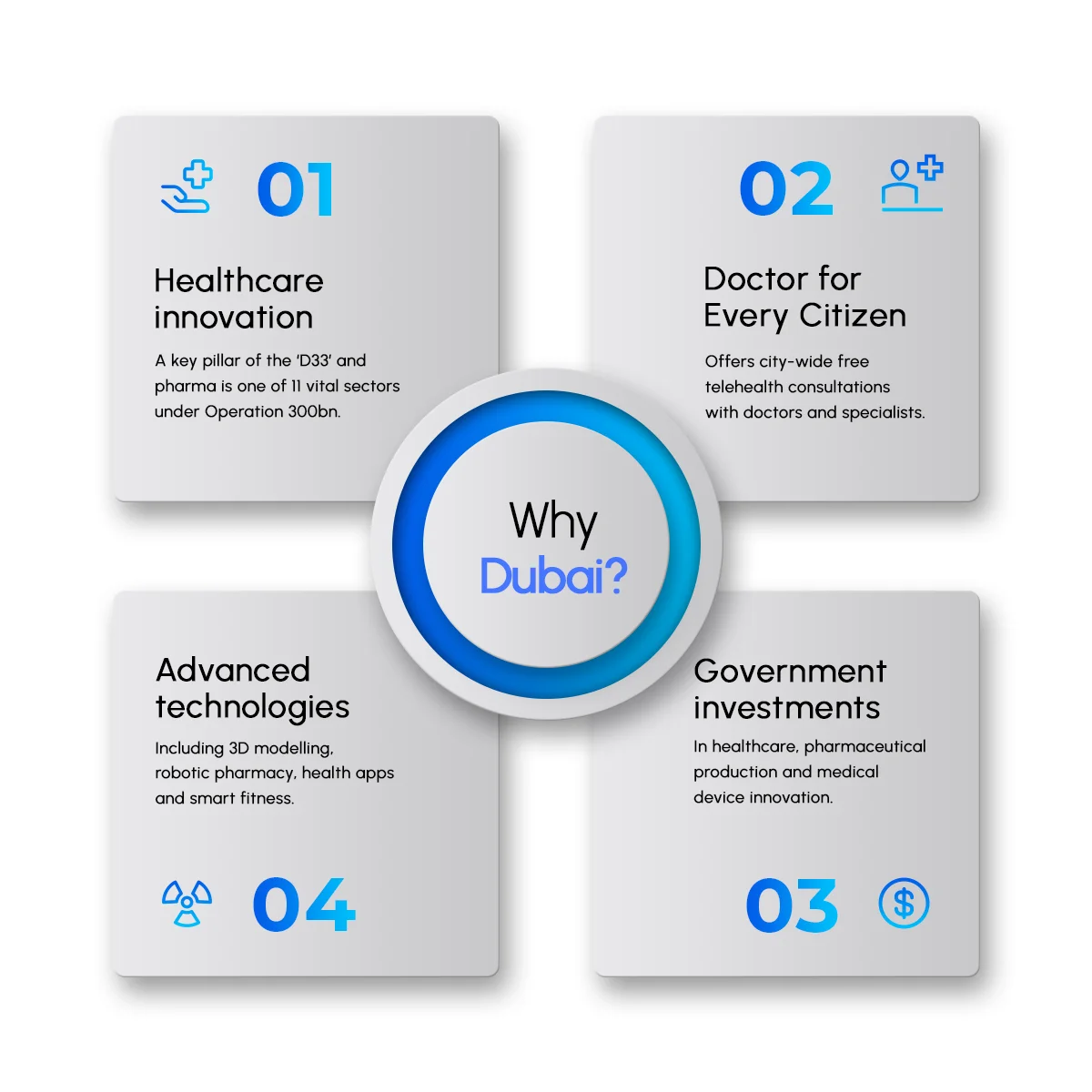
If you are thinking about starting a healthcare business setup in Dubai, you have chosen one of the world’s fastest-growing healthcare hubs. According to Invest in Dubai, when it comes to medical tourism, the city ranks 6th globally. It is the perfect destination for healthcare startups as the average annual value of the market is recorded at $4.63 billion in revenue. By 2029, the market value is expected to be around 5.1% of the country's overall GDP.
This growth reflects the rising demand and strong potential for business setup in Dubai. This article will give you elaborate instructions on how to start a healthcare business in Dubai. Read in detail about key steps in the process from choosing a structure and jurisdiction, to banking, visas and licensing.
Physician / nurse visas stamped & linked to Sheryan IDs ✓
8
DHA eClaim Portal
Payer-registration activated — Go live!
Note: Free-zone “express” healthcare packages can compress Weeks 1-5 into ≈10 days; banking KYC may extend
Week 6 for high-risk nationalities.
“Dubai is an ideal destination for healthcare investments with a world-class infrastructure and innovative initiatives. Dubai’s strategic location, advanced infrastructure, and robust regulatory environment provide a solid foundation for healthcare investors to build and grow successful businesses.”
- His Excellency Awadh Al Ketbi, Director General of the Dubai Health Authority
Step 1: Choose your healthcare business idea
Start by identifying the type of healthcare service you want to provide. This can include clinics, hospitals, medical centers, diagnostic labs, telemedicine platforms, pharmacy chains, rehabilitation centers or any other specialized healthcare services.
Key considerations for choosing your healthcare business model:
Patient segment
Determine if your business is focused on the needs of local residents, expatriates or medical tourism.
Service model
Decide which types of care you wish to provide such as an outpatient clinic, hospital services, mobile diagnostics or preventive care.
Regulatory impact
All healthcare businesses in Dubai must be approved by either the DHA (Dubai Health Authority), DHCC (Dubai Healthcare City) or the Ministry of Health and Prevention (MOHAP). Some specialties also require additional certifications.
Revenue planning
Plan your treatment fee structure, estimated patient volume, insurance partnerships, operating expenses and at least a simple 12-month cash-flow estimate.
Pro tip
Mainland licensing is needed for physical operations involving local patients. To provide specialized healthcare services for international or regional clients, free zones like DHCC are suitable.
Step 2: Choose a name
Your healthcare business name should meet the UAE naming guidelines and comply with the requirements set by DED. Avoid using names that reference religions, politics or sensitive medical terms. If required, add the legal identifiers "LLC", "FZ-LLC", "Clinic" or "Hospital". You should also obtain a domain name that matches your business name, then create an email address with this domain name. The DHA or DHCC will need to approve the trade name before you can use it.
Healthcare setup cost estimator (AED)
Estimated setup cost: —
Get detailed breakdown on WhatsApp
*Includes AED 1 350 for initial approval (150) + trade-name reservation (620) + DHA preliminary clearance (580).
Facility fit-out, medical equipment, malpractice insurance & bank guarantees vary—chat with us for an exact quote.
Step 3: Draft a business strategy
The next step is to create a clear business plan because it helps with approvals, bank account setup and investor discussions.
Outline your executive summary and a simple business model that explains your healthcare service, patient segment and the value you aim to offer.
Identify the activities you will be undertaking with the appropriate licensing codes for various services such as medical specialty, pharmacy, laboratory testing or telehealth.
Explain how you will be running your facility on a daily basis.
List the staff you will require including doctors, nurses, lab technicians and administrative personnel, along with your visa requirements.
Add a detailed breakdown of all of the financials that cover set-up costs, equipment, employee salary and estimated revenue.
Include the main compliance steps such as approval from DHA, DHCC or MOHAP.
Mention tax-related requirements such as VAT, corporate tax and ESR or UBO obligations.
Pro tip
Always keep a brief document of your company overview and projected patient flow and revenue in 2-3 pages.
Step 4: Select a business structure
Decide the appropriate structure for your healthcare business in Dubai.
LLC (Mainland)
You can set up an LLC on the mainland, which gives liability protection and is a great model for clinical care and hospital services primarily serving UAE residents. This will require a submission of the Memorandum of Association (MoA) to the relevant authorities.
Professional or medical establishments
Best suited when medical professionals join together to form a clinic or laboratory and their liabilities depend upon the license they hold.
Free zone
Free zone company formation in Dubai is available across various jurisdictions, while DHCC serves as the dedicated healthcare free zone for medical and clinical activities. It is the best option when considering full foreign ownership, and you can establish an FZ-LLC or FZE. This structure is ideal for medical consultancy, telemedicine or research-based services.
Branch or representative office
Good choice for international hospitals or diagnostic labs that want a presence in Dubai without forming a new company.
Quick fact
A 2023 study by the Dubai Health Authority reports that Dubai’s health tourism sector contributed AED 1.03 billion, reinforcing the strong demand for new healthcare services in the Emirate.
Planning to start a healthcare business in Dubai?
Visit our healthcare business setup page to learn how we help with approvals, licensing and end-to-end setup support.
Step 5: Choose your jurisdiction: Mainland vs free zone
Before choosing your jurisdiction, it is helpful to explore office space solutions in Dubai that meet DHA and Free Zone facility standards. Once you understand your space requirements, you can compare the mainland and free zone options.
Mainland
Required for clinics, hospitals and medical centers that directly focus on serving UAE patients.
Office lease needed (Ejari) and premises must meet DHA standards.
Easy access to government tenders and insurance partnerships.
Free zones (such as DHCC, DAFZA, DMCC)
Allows 100% foreign ownership, flexible visa quotas and specialized healthcare ecosystems (like DHCC). .
Focus is given to regional or international medical services, research and consultancy.
Onshore patient treatment usually requires DHA approval or dual licensing.
Quick fact
According to Invest in Dubai, DHCC includes ten hospitals, 168 clinical facilities and 95 regional headquarters of healthcare multinational firms, and its planned expansion is expected to contribute US$925.8 million (AED 3.4 billion) to Dubai’s GDP by 2030 while supporting more than 16,000 jobs.
Step 6: Register your healthcare business (license issuance)
After deciding on the structure and jurisdiction, the next step is to begin the licensing process.
For mainland company formation in Dubai, the Dubai Department of Economy and Tourism (DET) issues an initial approval to verify that your business activity and trade name are acceptable. Upon approval, you can get your healthcare authority license which includes facility inspections and licenses for all staff from the DHA. You can also obtain the trade license, establishment card, Ejari certificate and visa quota.
For free zone setups, the Free Zone Authority issues the license directly, while coordinating with the DHA to ensure all necessary medical approvals have been received. All free zone businesses require facility inspections and staff licensing.
External approvals depend on your healthcare activity.
The DHA handles clinics, hospitals, laboratories and pharmacies.
The DHCC oversees approvals of businesses located within the DHCC free zones.
The MOHAP is responsible for issuing approvals for private hospitals located outside Dubai city limits.
“Our comprehensive strategy to upgrade the quality of care will ensure that Dubai’s citizens, residents and visitors continue to receive high-quality medical care at modern facilities that are fully equipped to meet the potential needs of a rapidly growing population for specialized health services. ”
- His Highness Sheikh Hamdan bin Mohammed bin Rashid Al Maktoum, Crown Prince of Dubai and Chairman of the Dubai Executive Council
Step 7: Set up immigration and labor files; plan visas
Visa processing in Dubai is an easy and fast process with the help of expert PRO consultants. Investor or partner visas are issued to owners or directors while employment visas are granted to medical and support staff based on facility size and license categories. Specialized healthcare professionals are also considered for the Golden Visa.
Providing health insurance to staff is a legal requirement. Additionally, establish partnership with insurance providers to streamline patient billing and claims. Compliance with WPS (Wage Protection System) is required, which means all employee salaries must be paid through the government-approved payroll system.
Free 2025 Healthcare-Compliance Calendar (Excel)
Never miss DHA facility-licence renewals, MOHAP audits, or medical-waste contract expiry dates again. Tap below and we’ll WhatsApp the Excel sheet instantly.
Securing reliable corporate banking assistance in Dubai is much needed for smooth financial operations and you will receive guidance throughout the submission of the documents listed below. This includes your company profile with an overview of your business model, KYC documents for UBOs and licensed medical professionals, proof of premises along with your DHA or DHCC license, and your financial projections with initial contracts from insurance providers or suppliers.
Pro tip
Banks have specific requirements for healthcare businesses. Make sure all licensing, premises and staffing documents are complete.
Step 9: Apply for healthcare licenses, permits and external approvals
Beyond your primary trade license, you will need a few additional approvals to operate your healthcare facility smoothly.
A facility license from either DHA or DHCC which will confirm your category as a clinic, hospital or lab and requires annual inspections.
Professional licenses must also be obtained for all medical and technical staff through the DHA Sheryan system with exams required for certain positions.
Approval from MOHAP is needed if your facility plans to handle controlled drugs or imports medical equipment.
You will also need clearance from Dubai Municipality regarding signage, waste management and infection control practices.
Consent to provide telehealth or online services, to confirm that your permitted activities include remote consultation under DHA regulations.
Step 10: Explore funding options
There are several funding options available when starting a healthcare business in Dubai. Bootstrapping and revenue finance can support equipment leasing and service invoicing while angel investors and healthcare-focused VCs offer additional financial backing. You can also access banking facilities to begin financial operations. Government-supported initiatives including DHCC accelerator programs, provide further opportunities for growth. Partnerships with insurance companies or international hospital chains also strengthen your financial position.
Step 11: Stay on top of filings, renewals and taxes
To keep your healthcare business compliant, make sure you stay on top of the following key obligations:
Get annual license renewals and DHA/DHCC approvals.
Maintain regular UBO register and ESR compliance.
Verify VAT and corporate tax as per UAE law as healthcare services may have exemptions in certain situations.
Some free zones and hospital operations require audits.
Documentation of payroll, WPS compliance and gratuity management.
Updating renewals for healthcare-specific needs like staff licenses, HSE certifications, pharmacy inventory audits and medical waste disposal compliance.
Set up an internal compliance calendar to cover facility inspections, audits, insurance, VAT, visas and licenses.
Decision Snapshot (Healthcare)
Priority
Likely fit
Treating local UAE patients
Mainland + DHA license
Specialized, regional, or telehealth services
DHCC Free Zone
Holding healthcare IP/research
Offshore or Free Zone SPV
Pro tips
To get DHA approval, ensure the right activity and licensing codes.
Maintain an easily accessible file for licenses, staff credentials, contracts and other approvals.
Facility size determines the overall visa quota for medical staff.
Keep a 12 to 18 month compliance outlook for licenses, staff renewals, VAT and audits.
Choosing the wrong activity code (e.g. “Clinic” vs. “Day-Surgery Centre”)—DET will reject the file.
Submitting without a DHA-licensed Medical Director—application auto-returns.
Starting fit-out before obtaining DHA/DM Health Facility Planning approval—retrofitting costs 3× more.
Skipping mandatory SHS & Infection-Control plans—can delay inspection by weeks.
Using a PO-box only; insurers and DHA inspections require a physical facility address.
Ignoring PDPL & HIPAA-style data-protection policies for EMR storage—risk of fines.
UAE launches licence transfer for healthcare professionals – 10 Aug 2025:
Healthcare workers can transfer licences between DHA and DoH-Abu Dhabi without reassessment, cutting steps, documents and approval times.
MoHAP cuts service steps by 50% – 4 Aug 2025:
MoHAP has simplified many healthcare services, cutting steps and documents to make licensing and approvals faster and easier under new Zero Bureaucracy roadmap.
DoH issues revised Medical Waste Management Standard – Sep 2025:
Medical-waste rules updated for all licensed healthcare providers with tighter storage, transport, treatment and record-keeping requirements.
UAE Health Ministry launches digital fines collection system – 16 Jun 2025:
MoHAP adopts a new digital platform to monitor and collect fines, automating workflows and offering multiple online payment options.
DHA deploys AI-powered privacy system to protect patient data – 27 Apr 2025:
DHA integrates AI-driven Privacy Intelligence into NABIDH to detect unauthorised access, strengthen data security and improve compliance.
UAE launches unified national platform for health-professional licensing – 1 Feb 2025:
MoHAP rolls out a single digital licensing system for doctors, nurses and allied health staff, reducing approval times across all emirates.
MoHAP deploys AI system to auto-check healthcare facility designs – 29 Jan 2025:
New AI system reviews medical centre blueprints, detects design violations and accelerates licensing approvals with more compliance checks.
Glossary of acronyms
DHA - Dubai Health Authority
MOHAP - Ministry of Health & Prevention
SEHA - Abu Dhabi Health Services Company
PDPL - UAE Personal Data Protection Law
EMR - Electronic Medical Record
SHS - Safe Healthcare Services plan
CT - Corporate Tax (9 %)
VAT - Value-Added Tax
FAQs
Dubai welcomes investors to start clinics, hospitals, diagnostic labs, pharmacies, wellness centers, telemedicine platforms, medical research and health-tech services.
Approvals for mainland setups are handled by the DED and DHA, while MOHAP issues the license when federal approval is required. In DHCC Free Zone setups, the DHCC authority manages approvals and coordinates with DHA when necessary.
The time required to obtain a healthcare license can vary based on factors such as trade name reservation, initial approvals and whether you choose a Mainland or Free Zone setup. Facility and professional licensing through DHA or MOHAP may take additional time and Free Zone licensing timelines differ depending on the authority.
UAE national representation is available for only some hospitals and specialized services. Most healthcare businesses in DHCC and certain clinics on the mainland allow 100% foreign ownership.
Yes, healthcare businesses need to follow UAE VAT and corporate tax rules. Exceptions to tax rules are available for specific income sources in qualifying free zones.
Unsure about approvals, costs, or documentation?
Book a free consultation with our healthcare setup experts and get clear guidance on licensing, permits and location requirements.
Disclaimer: This content is for informational purposes only and does not constitute legal
advice. Business setup regulations can change. Always consult with a qualified professional for your
specific needs.